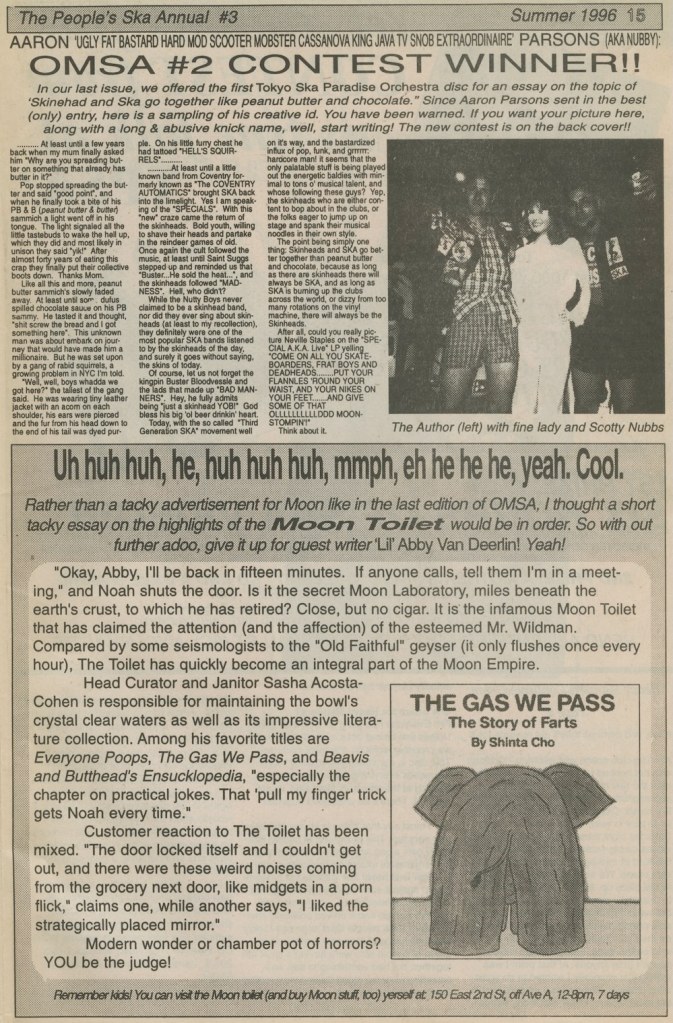
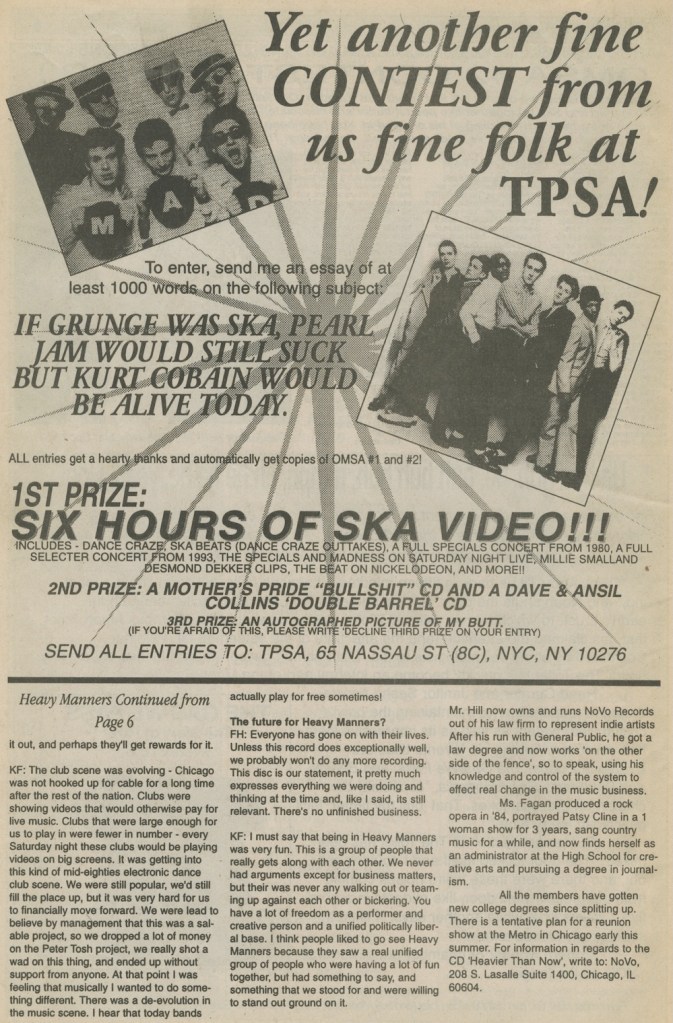
Summer 1996, May 7th
A Muse Letter for the people about Ska Music straight from the pen of one over opinionated close-cropped fan.
Cover
SUMMER
Page 2
TABLE OF CONTENTS

Page 3
INTERVIEW

Page 4
HEAVY MANNERS
Page 5
HEAVY MANNERS CONT.
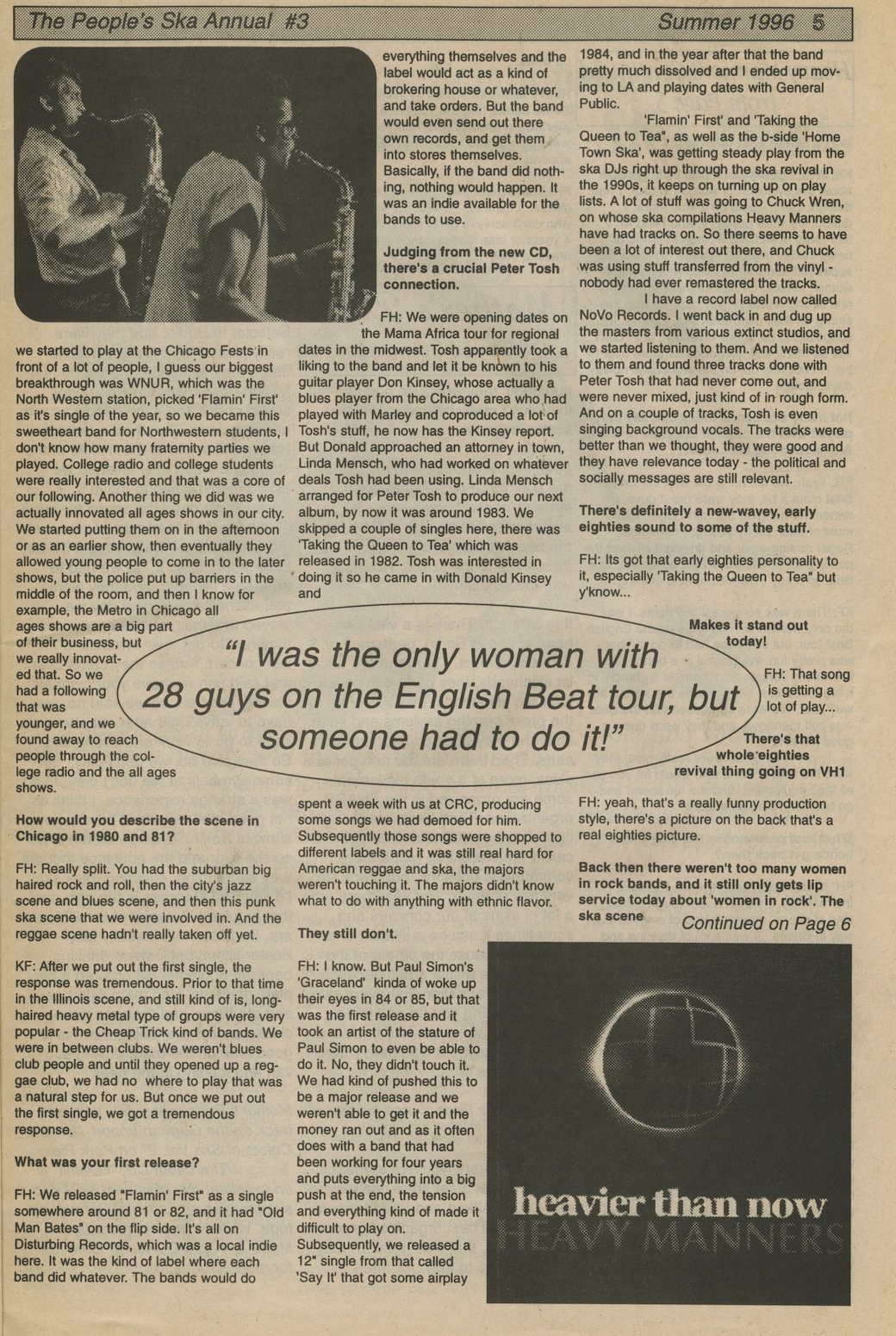
Page 6
INTERVIEWS CONT.
Page 7
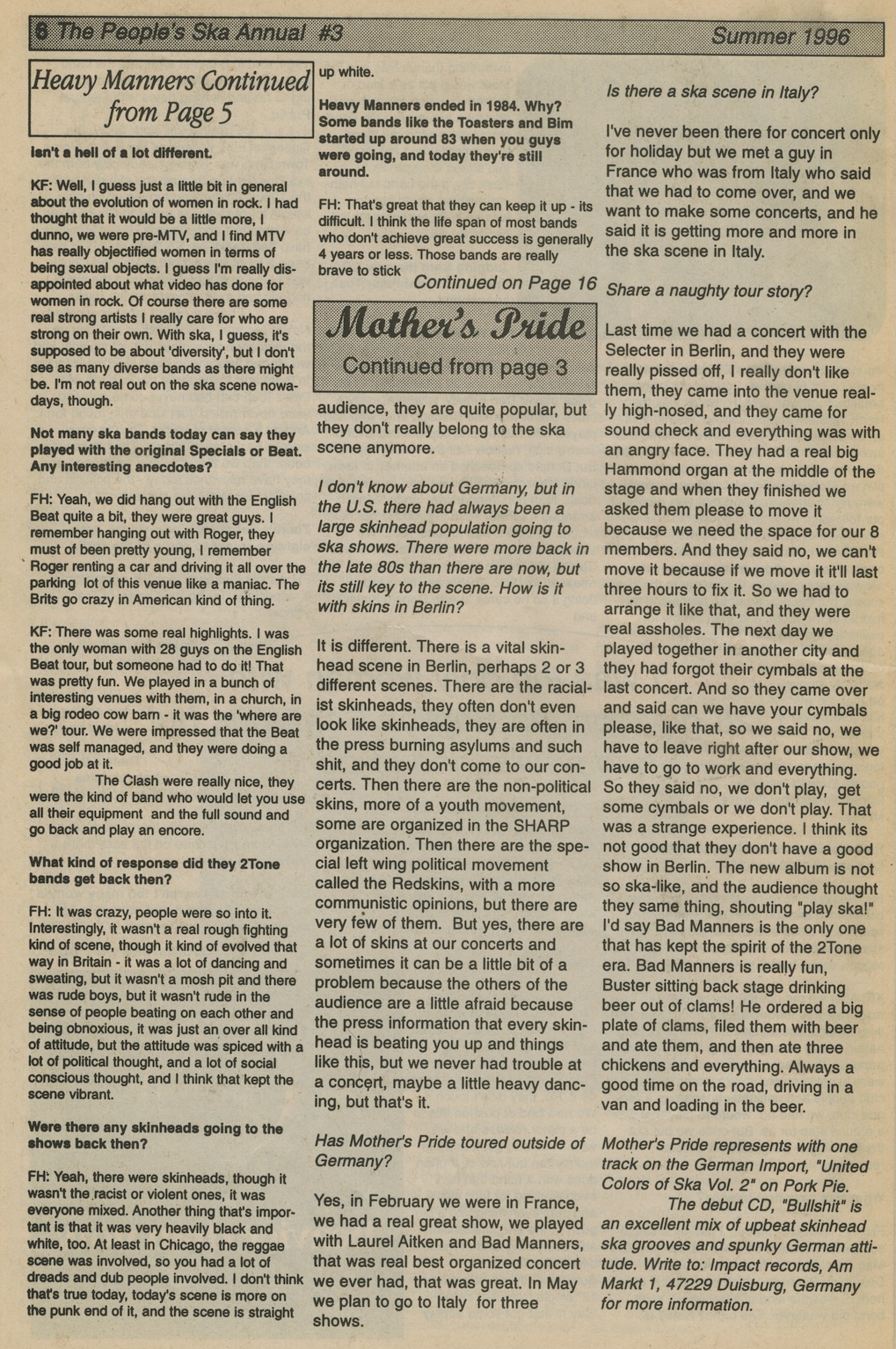
BEAVIS & BUTTHEAD
Page 8
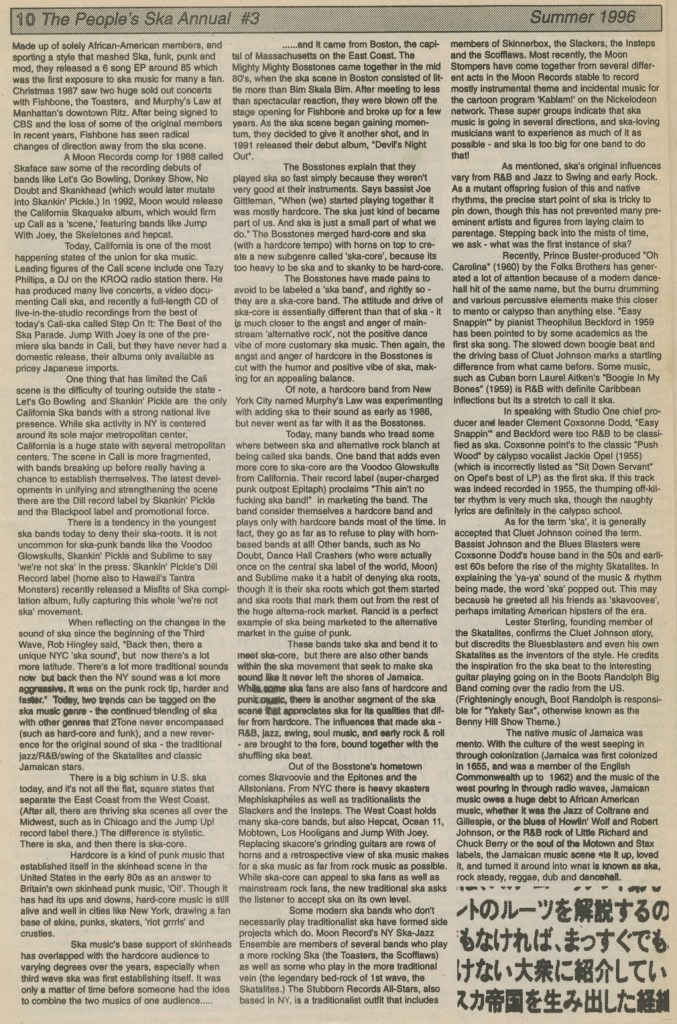
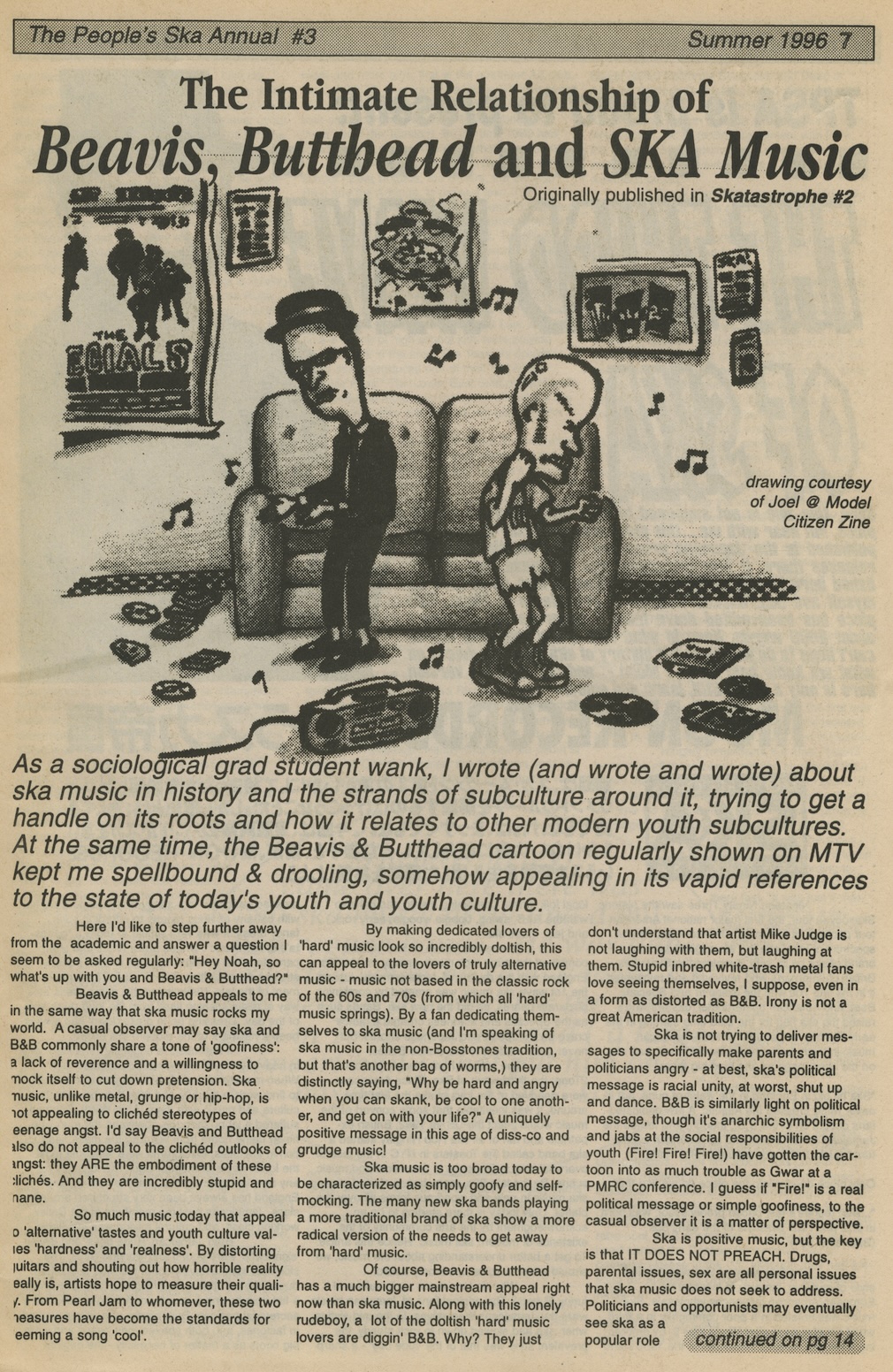
3rd WAVE SKA
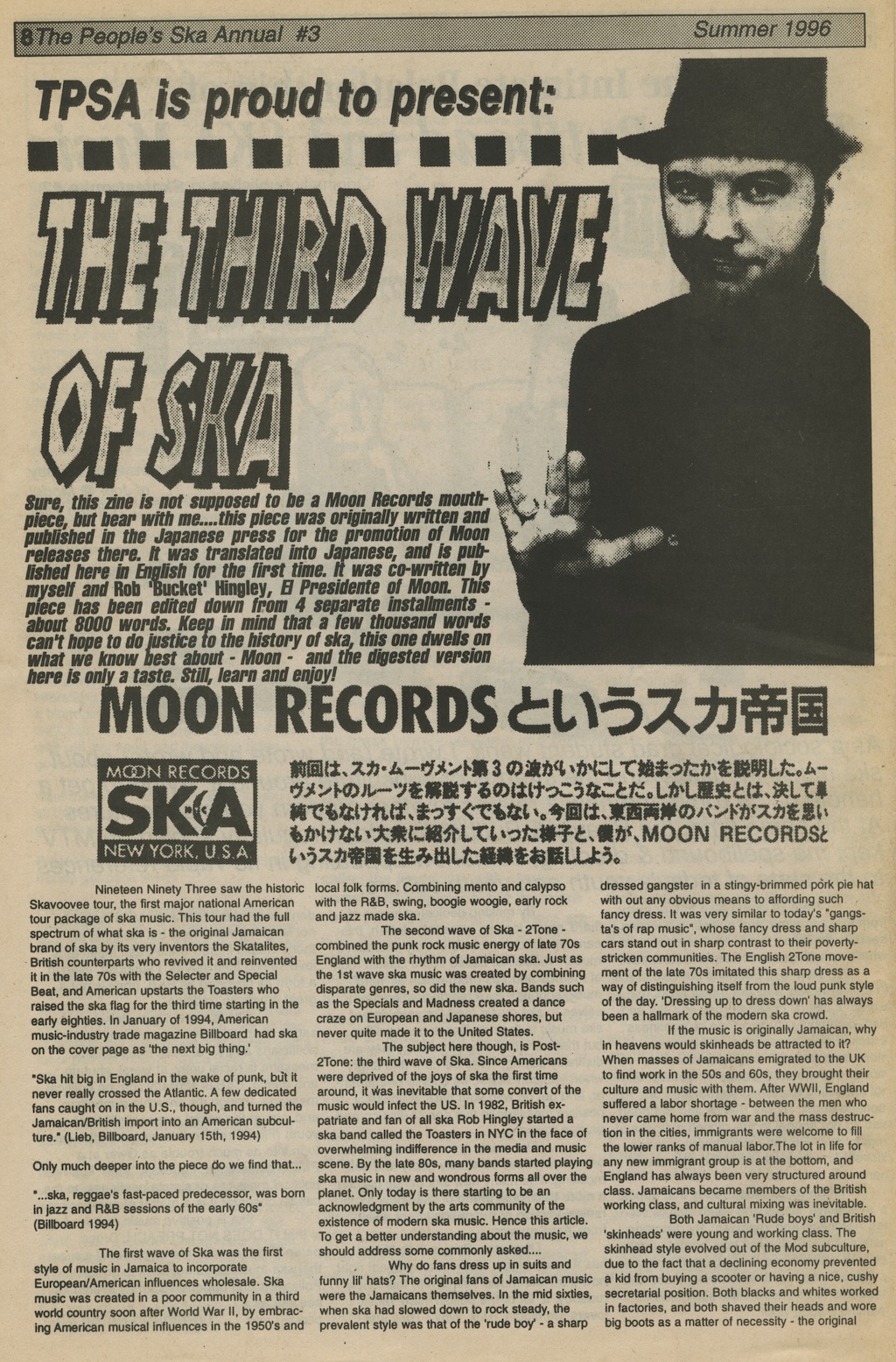
Page 9
3rd WAVE SKA CONT.

Page 10
3rd WAVE SKA CONT.
Page 11
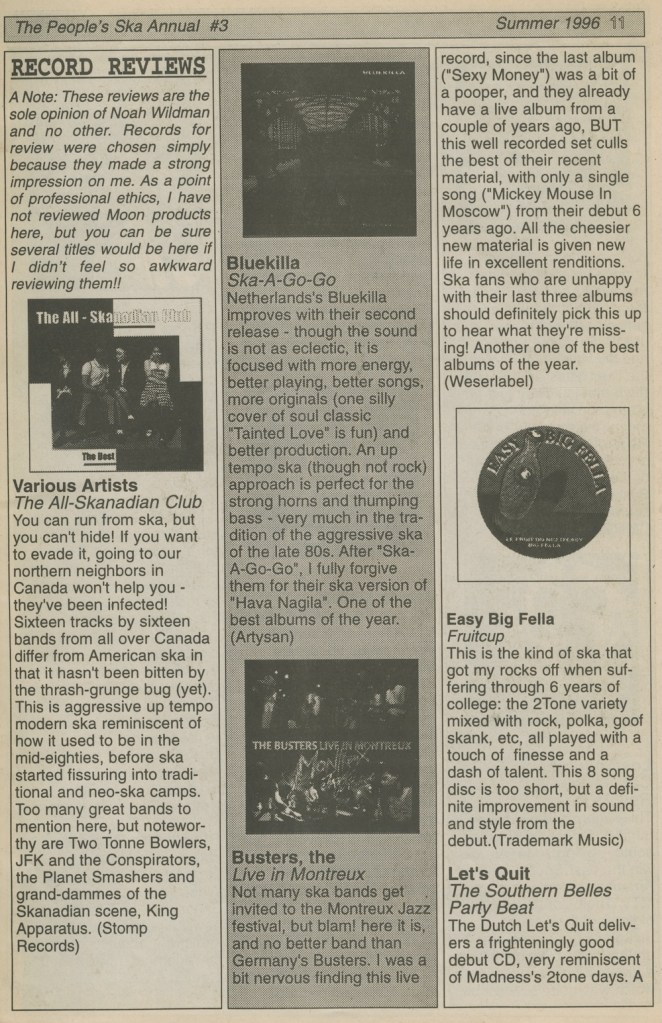
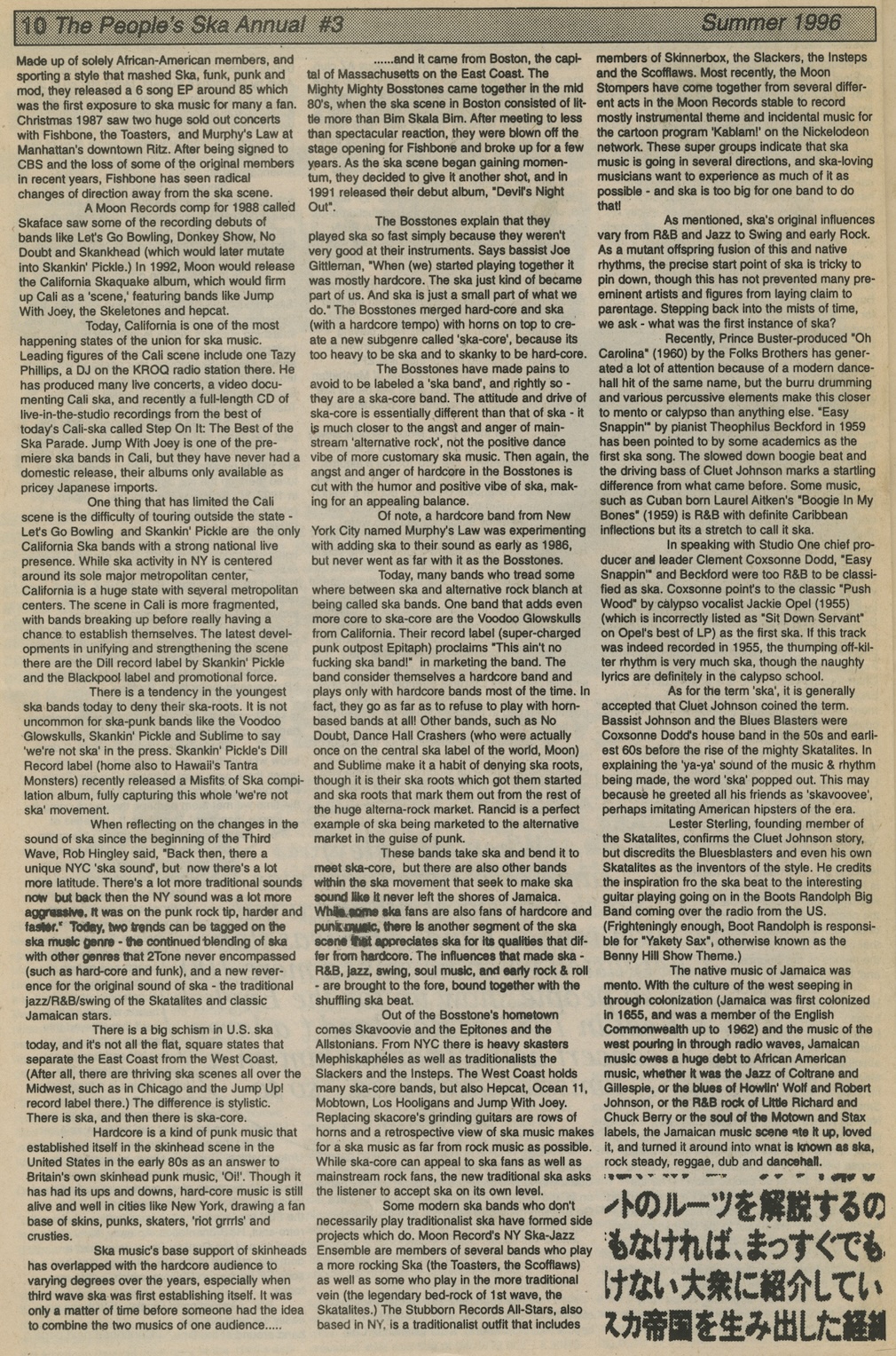
RECORD REVIEWS
Page 12
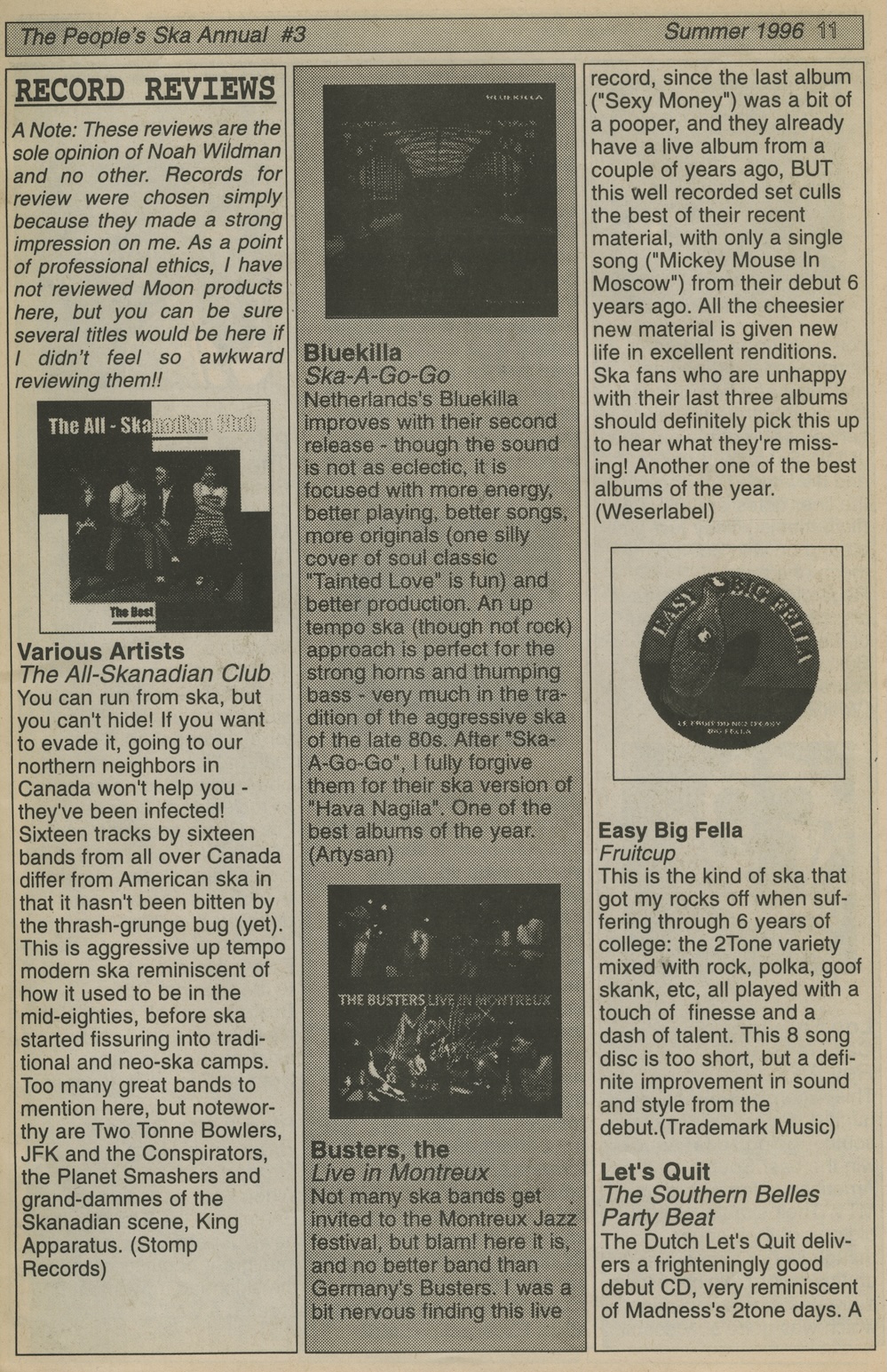
RECORD REVIEWS
Page 13
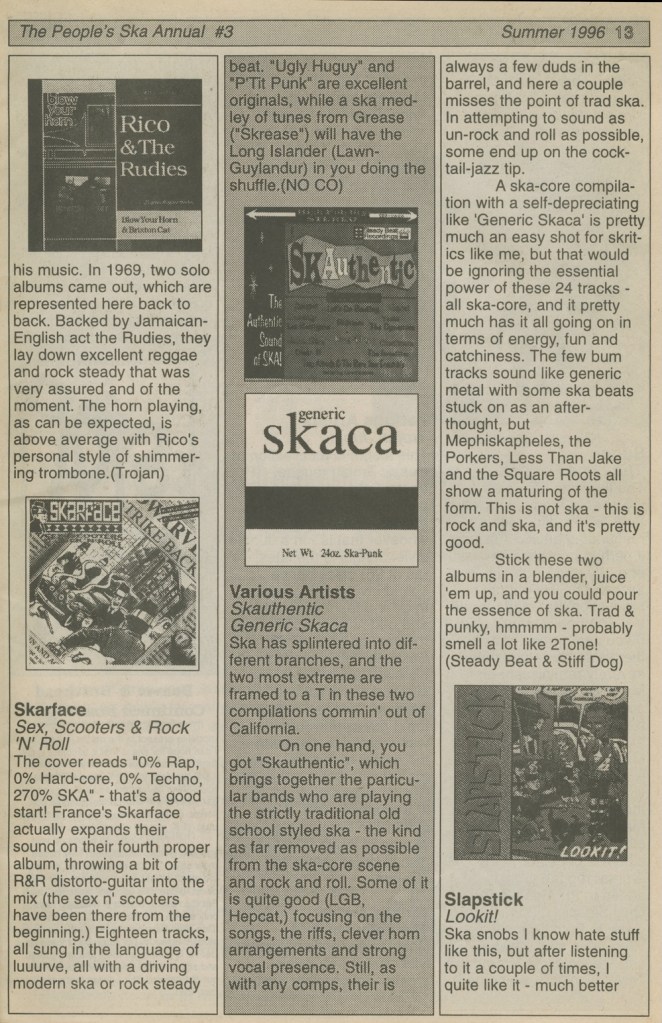
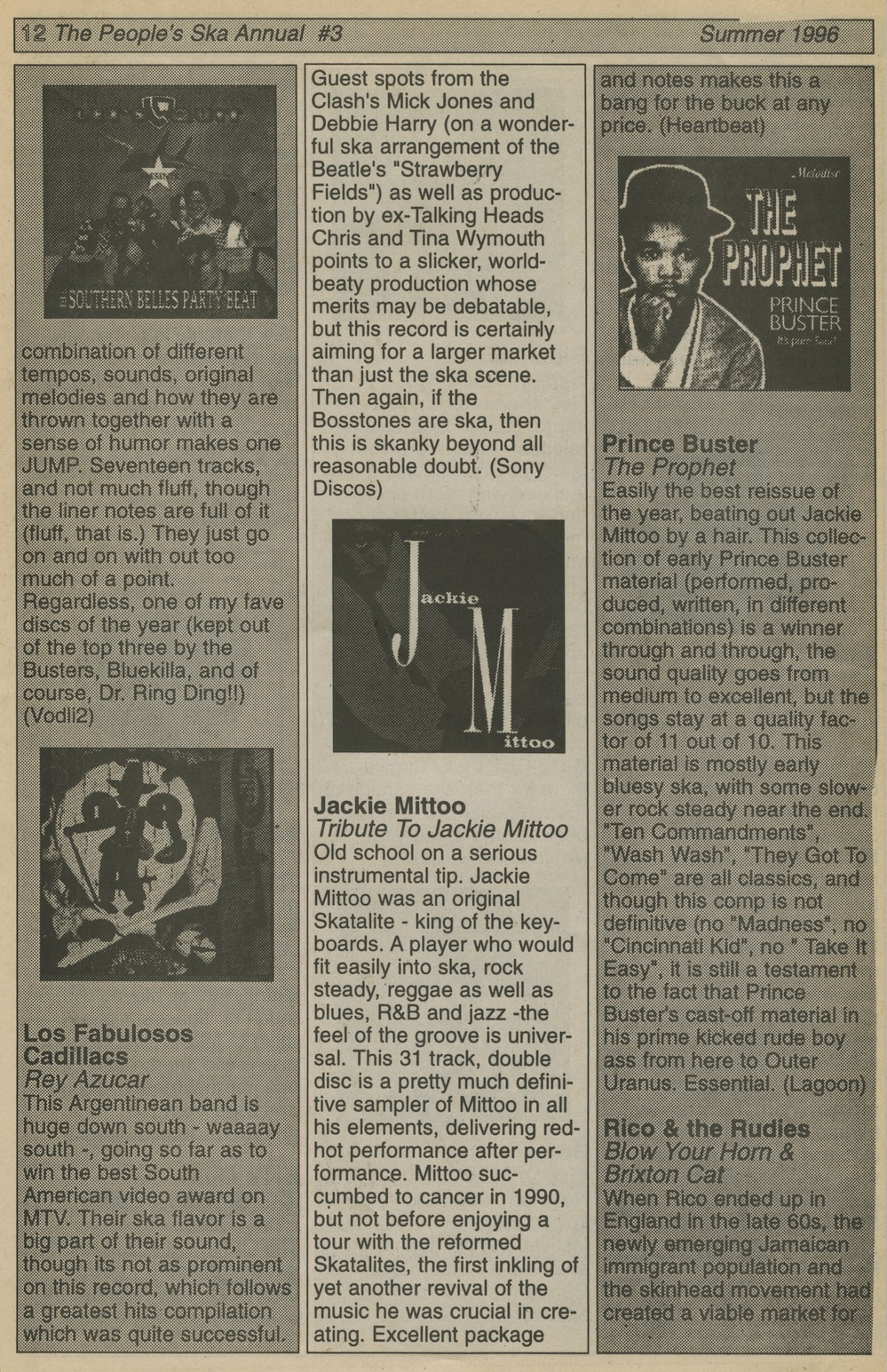
RECORD REVIEWS
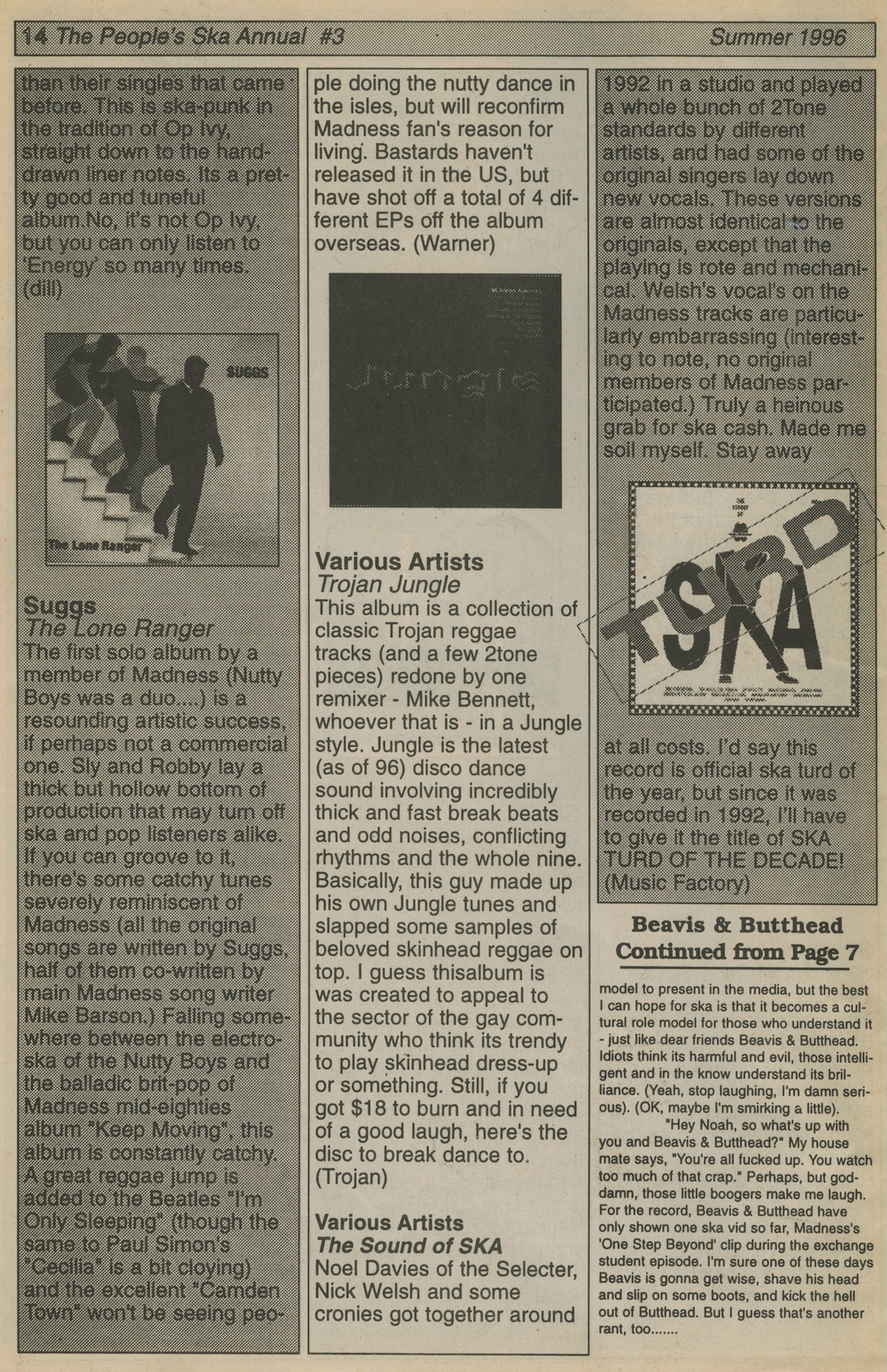
Page 14
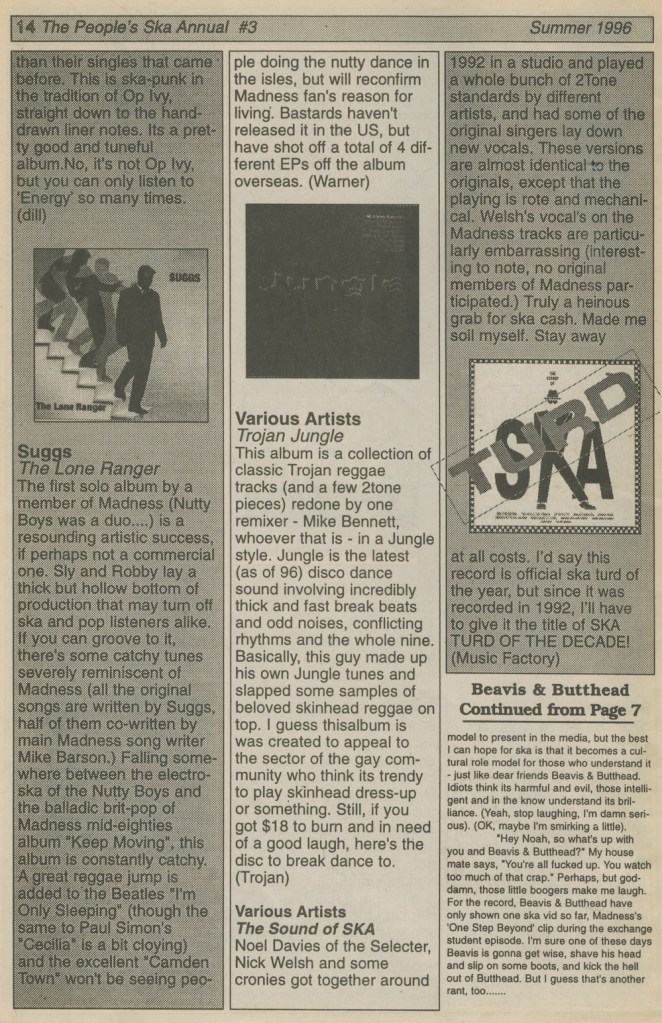
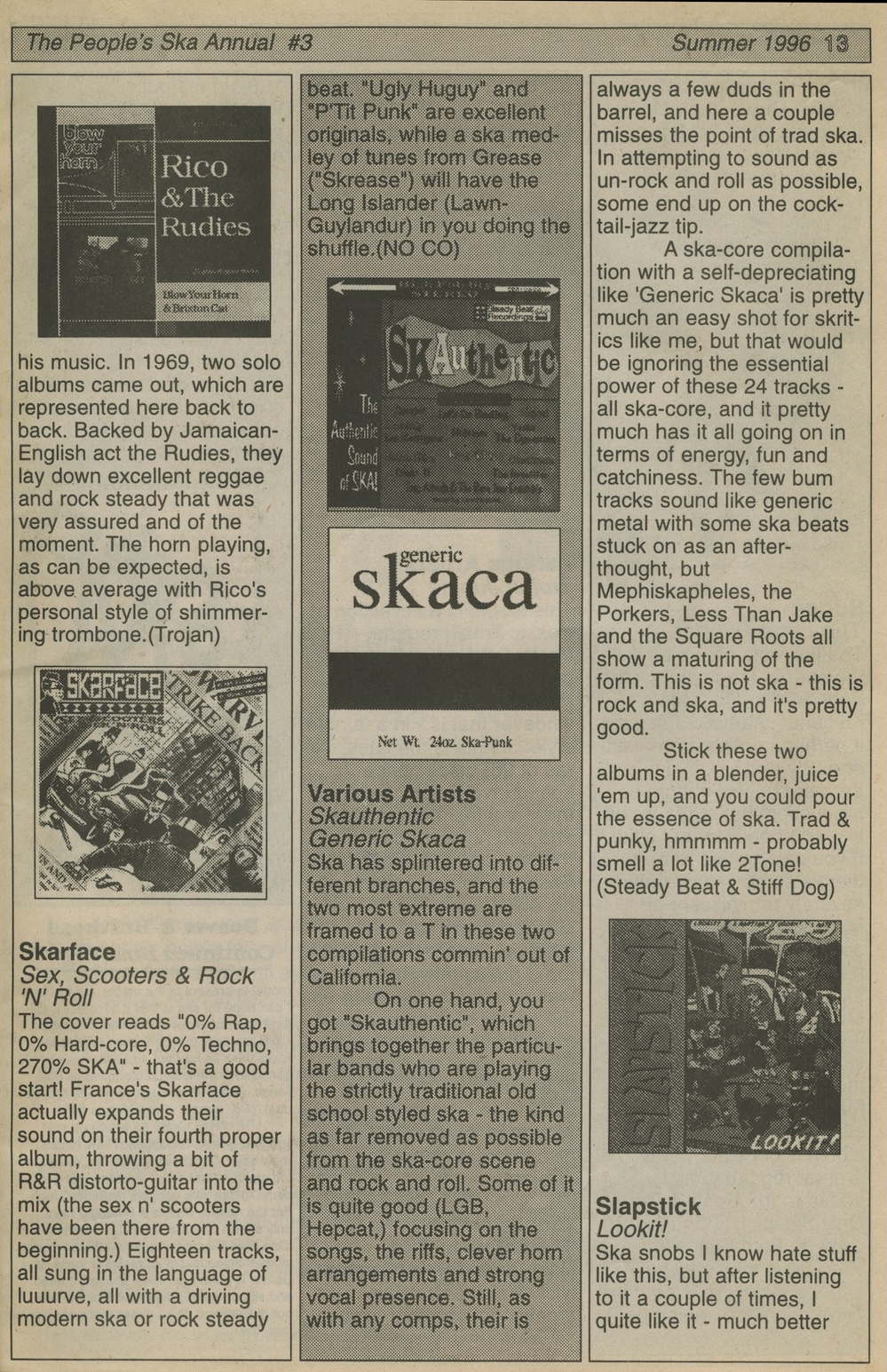
RECORD REVIEWS
Page 15
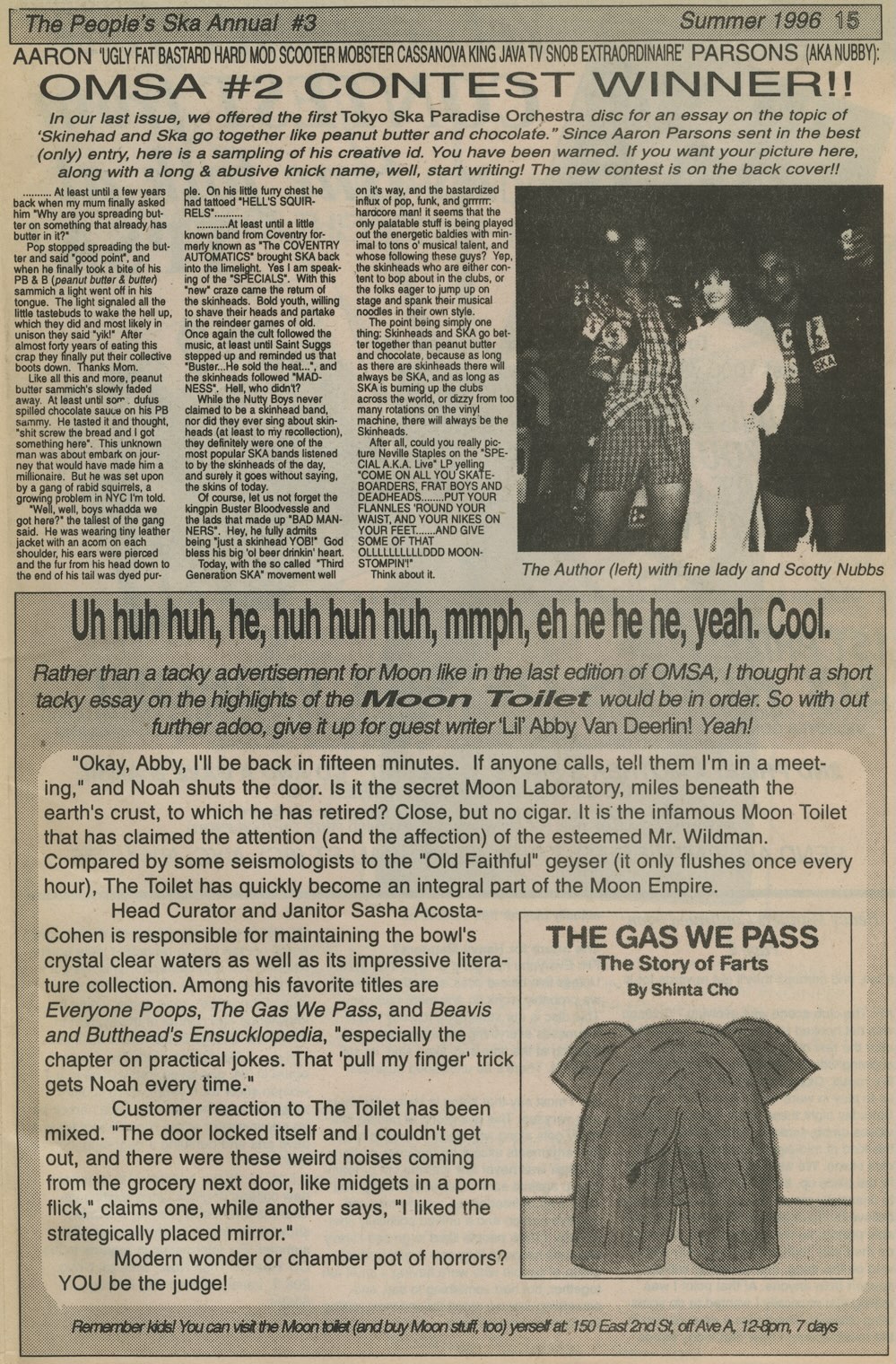
CONTEST
Page 16
WRAP UP
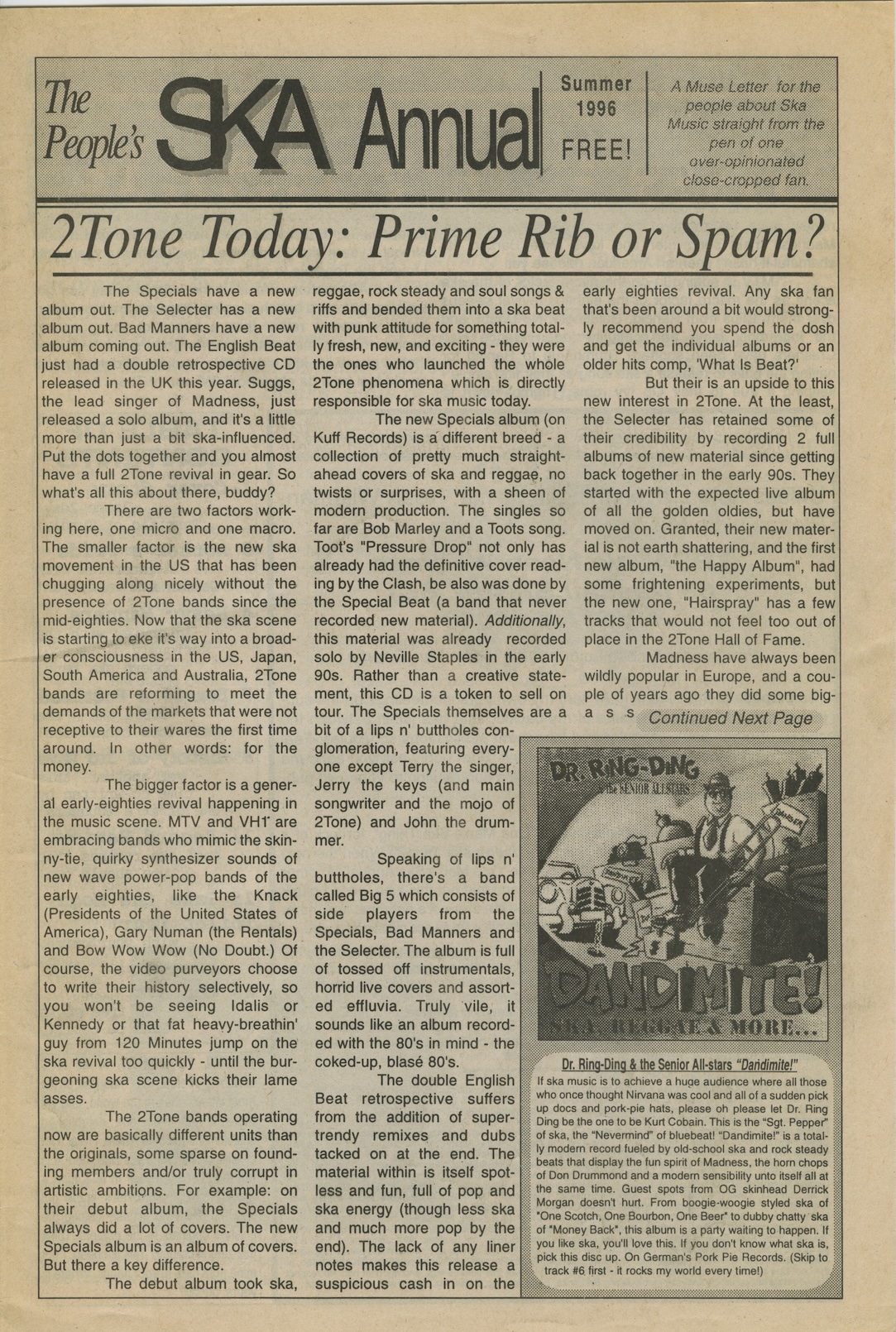
2Tone Today: Prime Rib or Spam?
The Specials have a new album out. The Selecter has a new album out. Bad Manners have a new album coming out. The English Beat just had a double retrospective CD released in the UK this year. Suggs, the lead singer of Madness, just released a solo album, and it’s a little more than just a bit ska-influenced.
Put the dots together and you almost have a full Tone revival in gear. So what’s all this about there, buddy There are two factors working here, one micro and one macro. The smaller factor is the new ska movement in the US that has been chugging along nicely without the presence of Tone bands since the mid-eighties. Now that the ska scene is starting to eke it’s way into a broader consciousness in the US, Japan, South America and Australia, 2Tone bands are reforming to meet the demands of the markets that were not receptive to their wares the first time around. In other words: for the money.
The bigger factor is a general early-eighties revival happening in the music scene. MTV and VH1 are embracing bands who mimic the skinny-tie, quirky synthesizer sounds of new wave power-pop bands of the early eighties, like the Knack (Presidents of the United States of America), Gary Numan (the Rentals) and Bow Wow Wow (No Doubt.) Of course, the video purveyors choose to write their history selectively, so you won’t be seeing Idalis or Kennedy or that fat heavy-breathin’ guy from 120 Minutes jump on the ska revival too quickly – until the burgeoning ska scene kicks their lame asses.
The 2Tone bands operating now are basically different units than the originals, some sparse on founding members and/or truly corrupt in artistic ambitions. For example: on their debut album, The Specials always did a lot of covers. The new Specials album is an album of covers. But there’s a key difference. The debut album took ska, reggae, rock steady and soul songs & riffs and bended them into a ska beat with punk attitude for something totally fresh, new, and exciting – they were the ones who launched the whole 2Tone phenomena which is directly responsible for ska music today. The new Specials album (on Kuff Records) is a different breed – a collection of pretty much straight-ahead covers of ska and reggae, no twists or surprises, with a sheen of modern production.
The singles so far are Bob Marley and a Toots song. Toot’s “Pressure Drop” not only has already had the definitive cover reading by The Clash, but also was done by The Special Beat (a band that never recorded new material). Additionally, this material was already recorded solo by Neville Staples in the early 90s. Rather than a creative statement, this CD is a token to sell on tour. The Specials themselves are a bit of a lips n’ buttholes conglomeration, featuring everyone except Terry the singer, Jerry the keys (and main songwriter and the mojo of 2Tone) and John the drummer.
Speaking of lips n’ buttholes, there’s a band called Big 5 which consists of side players from The Specials, Bad Manners and The Selecter. The album is full of tossed off instrumentals, horrid live covers and assorted effluvia. Truly vile, it sounds like an album recorded with the 80’s in mind – the coked-up, blasé 80’s.
The double English Beat retrospective suffers from the addition of super-trendy remixes and dubs tacked on at the end. The material within is itself spotless and fun, full of pop and ska energy (though less ska and much more pop by the end). The lack of any liner notes makes this release a suspicious cash in on the early eighties revival. Any ska fan that’s been around a bit would strongly recommend you spend the dosh and get the individual albums or an older hits comp, ‘What Is Beat?’
But there is an upside to this new interest in 2Tone. At the least, The Selecter has retained some of their credibility by recording 2 full albums of new material since getting back together in the early 90s. They started with the expected live album of all the golden oldies, but have moved on. Granted, their new material is not earth shattering, and the first new album, “the Happy Album”, had some frightening experiments, but the new one, “Hairspray” has a few tracks that would not feel too out of place in the 2Tone Hall of Fame.
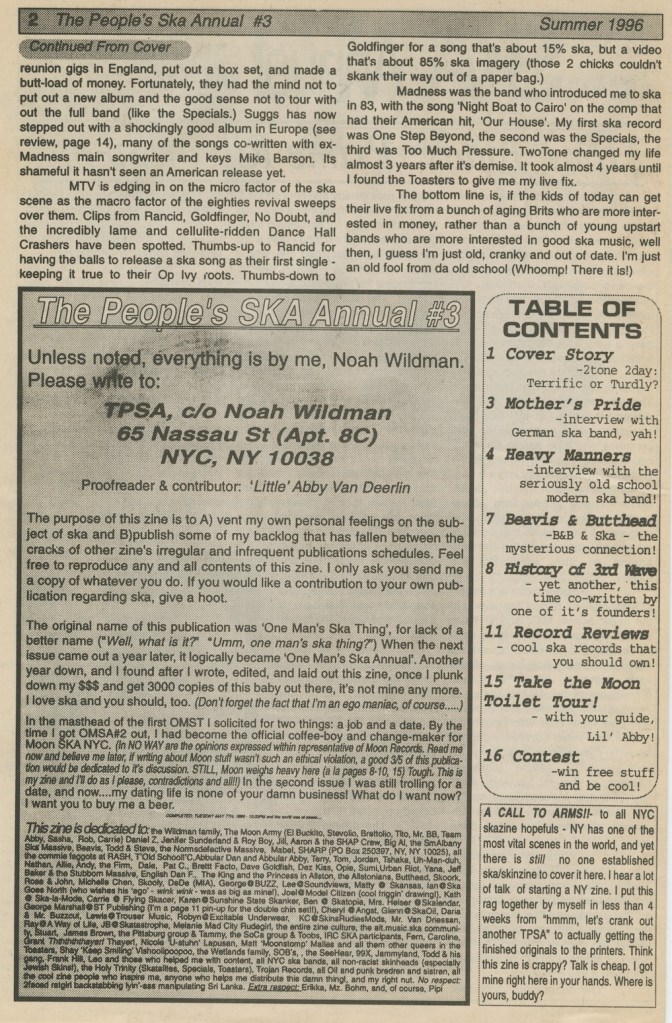
Madness have always been wildly popular in Europe, and a couple of years ago they did some big-ass reunion gigs in England, put out a box set, and made a butt-load of money. Fortunately, they had the mind not to put out a new album and the good sense not to tour with out the full band (like The Specials.) Suggs has now stepped out with a shockingly good album in Europe (see review, page 14), many of the songs co-written with ex-Madness main songwriter and keys Mike Barson. It’s shameful it hasn’t seen an American release yet.
MTV is edging in on the micro factor of the ska scene as the macro factor of the eighties revival sweeps over them. Clips from Rancid, Goldfinger, No Doubt, and the incredibly lame and cellulite-ridden Dance Hall Crashers have been spotted. Thumbs-up to Rancid for having the balls to release a ska song as their first single – keeping it true to their Op Ivy roots. Thumbs-down to Goldfinger for a song that’s about 15% ska, but a video that’s about 85% ska imagery (those 2 chicks couldn’t skank their way out of a paper bag.)
Madness was the band who introduced me to ska in ’83, with the song ‘Night Boat To Cairo’ on the comp that had their American hit, ‘Our House’. My first ska record was “One Step Beyond”, the second was The Specials, the third was “Too Much Pressure”. TwoTone changed my life almost 3 years after it’s demise. It took almost 4 years until I found The Toasters to give me my live fix.
The bottom line is, if the kids of today can get their live fix from a bunch of aging Brits who are more interested in money, rather than a bunch of young upstart bands who are more interested in good ska music, well then, I guess I’m just old, cranky and out of date. I’m just an old fool from da old school (Whoomp! There it is!)
Record Reviews

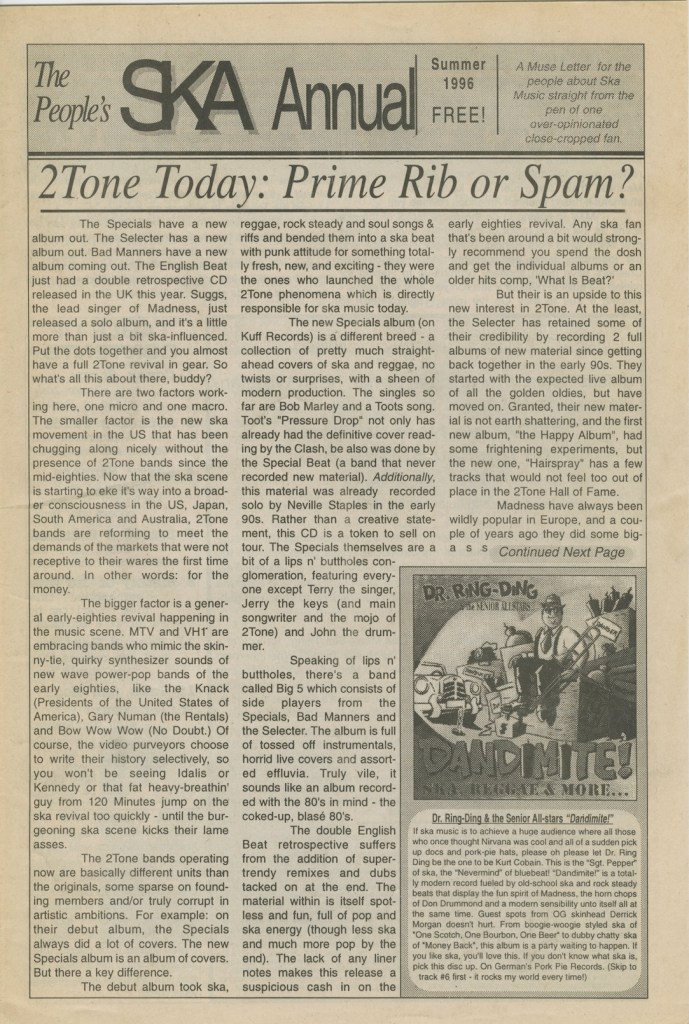
Dr. Ring-Ding & the Senior All-stars “Dandimite!”
If ska music is to achieve a huge audience where all those who once thought Nirvana was cool and all of a sudden pick up docs and pork-pie hats, please oh please let Dr. Ring Ding be the one to be Kurt Cobain. This is the “Sgt. Pepper” of ska, the “Nevermind” of bluebeat! “Dandimite!” is a totally modern record fueled by old-school ska and rock steady beats that display the fun spirit of Madness, the horn chops of Don Drummond and a modern sensibility unto itself all at the same time. Guest spots from OG skinhead Derrick Morgan doesn’t hurt. From boogie-woogie styled ska of
“One Scotch, One Bourbon, One Beer” to dubby chatty ska of “Money Back”, this album is a party waiting to happen. If you like ska, you’ll love this. If you don’t know what ska is, pick this disc up. On German’s Pork Pie Records. (Skip to track #6 first – it rocks my world every time!)
Interview(s)
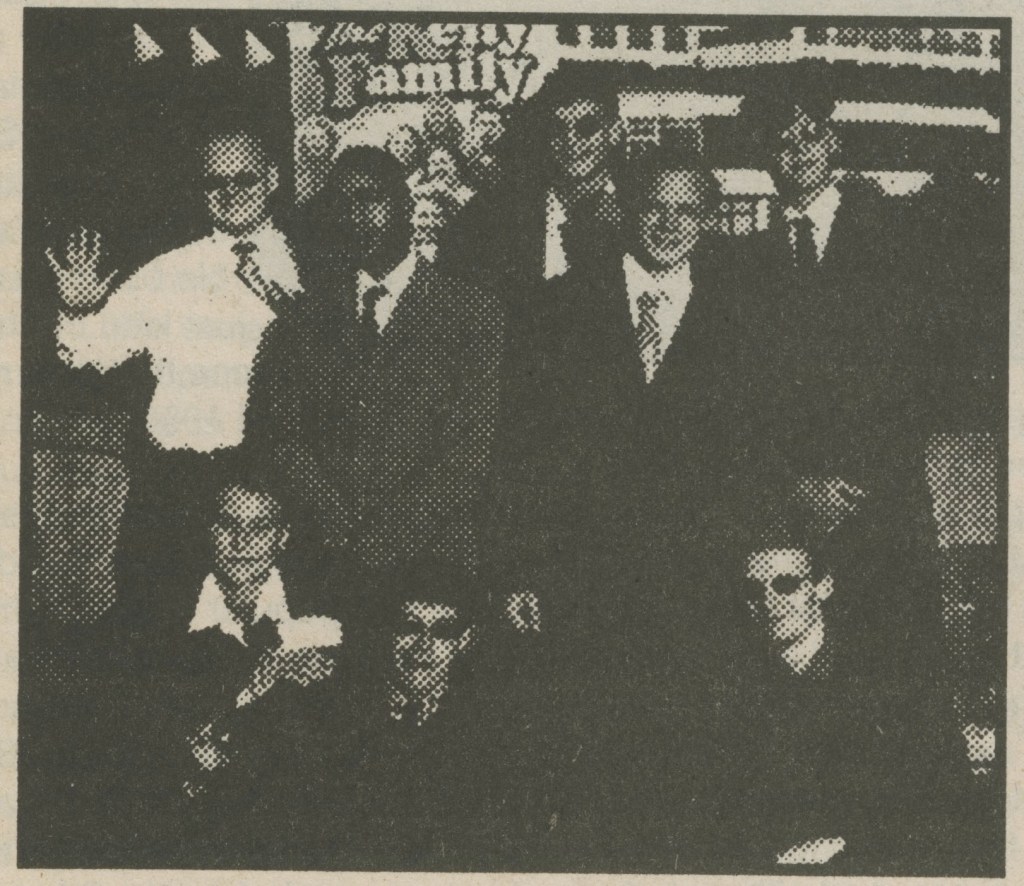
- There are plenty of great ska bands forming all over the world this decade – in the States, in Japan, in South America, in Australia, and in Europe (just about everywhere except the homeland of ska, Jamaica.) I had an opportunity to drink with the manager of one of Germany’s up-and-coming ska bands, Mother’s Pride.
- Dateline: 3/28/96 at the Lower East Side’s Sophie’s.
- Drinks: pints of McSorley’s dark.
Mother’s Pride
- NW – Tell me about Mother’s Pride.
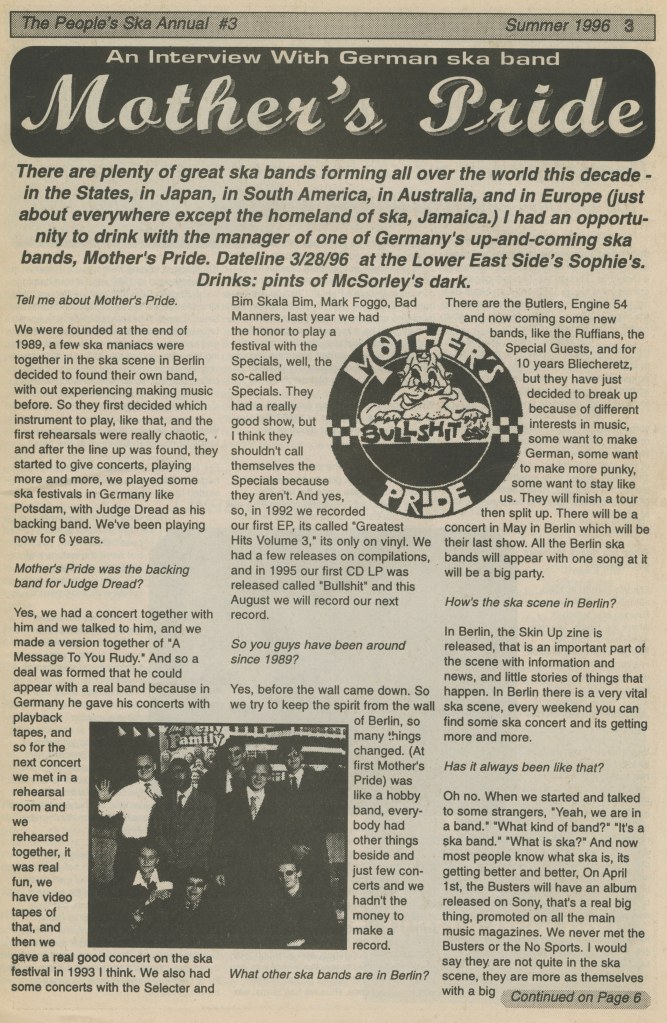
- MP – We were founded at the end of 1989, a few ska maniacs were together in the ska scene in Berlin decided to found their own band, with out experiencing making music before. So they first decided which instrument to play, like that, and the first rehearsals were really chaotic, and after the line up was found, they started to give concerts, playing more and more, we played some ska festivals in Germany like Potsdam, with Judge Dread as his backing band. We’ve been playing now for 6 years.
- NW – Mother’s Pride was the backing band for Judge Dread?
- MP – Yes, we had a concert together with him and we talked to him, and we made a version together of “A Message To You Rudy.” And so a deal was formed that he could appear with a real band because in Germany he gave his concerts with playback tapes, and so for the next concert we met in a rehearsal room and we rehearsed together, it was real fun, we have video tapes of that, and then we gave a real good concert on the ska festival in 1993 | think.
We also had some concerts with The Selecter and Bim Skala Bim, Mark Foggo, Bad Manners, last year we had the honor to play a festival with The Specials, well, the so-called Specials. They had a really good show, but I think they shouldn’t call themselves The Specials because they aren’t.
And yes, so, in 1992 we recorded our first EP, it’s called “Greatest Hits Volume 3,” it’s only on vinyl. We had a few releases on compilations and in 1995 our first CD LP was released called “Bullshit” and this August we will record our next record. - NW – So you guys have been around since 1989?
- MP – Yes, before the wall came down. So we try to keep the spirit from the wall of Berlin, so many things changed. At first (Mother’s Pride) was like a hobby band, everybody had other things beside and just few concerts and we hadn’t the money to make a record.
- NW – What other ska bands are in Berlin?
- MP – There are the Butlers, Engine 54 and now coming some new bands, like The Ruffians, The Special Guests, and for 10 years Bliecheretz, but they have just decided to break up because of different interests in music, some want to make German, some want to make more punky, some want to stay like us. They will finish a tour then split up. There will be a concert in May in Berlin which will be their last show. All the Berlin ska bands will appear with one song at it will be a big party.
- NW – How’s the ska scene in Berlin?
- MP – In Berlin, the Skin Up zine is released, that is an important part of the scene with information and news, and little stories of things that happen. In Berlin there is a very vital ska scene, every weekend you can find some ska concert and its getting more and more.
- NW – Has it always been like that?
- MP – Oh no. When we started and talked to some strangers, “Yeah, we are in a band.” “What kind of band?” “It’s a ska band.” “What is ska?” And now most people know what ska is, its getting better and better, On April 1st, The Busters will have an album released on Sony, that’s a real big thing, promoted on all the main music magazines. We never met The Busters or the No Sports. I would say they are not quite in the ska scene, they are more as themselves with a big audience, they are quite popular, but they don’t really belong to the ska scene anymore.
- NW – I don’t know about Germany, but in the U.S. there had always been a large skinhead population going to ska shows. There were more back in the late 80s than there are now, but it’s still key to the scene. How is it with skins in Berlin?
- MP – It is different. There is a vital skinhead scene in Berlin, perhaps 2 or 3 different scenes. There are the racialist skinheads, they often don’t even look like skinheads, they are often in the press burning asylums and such shit, and they don’t come to our concerts. Then there are the non-political skins, more of a youth movement, some are organized in the SHARP organization. Then there are the special left wing political movement called the Redskins, with a more communistic opinions, but there are very few of them. But yes, there are a lot of skins at our concerts and sometimes it can be a little bit of a problem because the others of the audience are a little afraid because the press information that every skinhead is beating you up and things like this, but we never had trouble at a concert, maybe a little heavy dancing, but that’s it.
- NW – Has Mother’s Pride toured outside of Germany?
- MP – Yes, in February we were in France, we had a real great show, we played with Laurel Aitken and Bad Manners, that was real best organized concert we ever had, that was great. In May we plan to go to Italy for three shows Is there a ska scene in Italy. I’ve never been there for concert only for holiday but we met a guy in France who was from Italy who said that we had to come over, and we want to make some concerts, and he said it is getting more and more in the ska scene in Italy.
- NW – Share a naughty tour story?
- MP – Last time we had a concert with The Selecter in Berlin, and they were really pissed off, I really don’t like them, they came into the venue really high-nosed, and they came for sound check and everything was with an angry face. They had a real big Hammond organ at the middle of the stage and when they finished we asked them please to move it because we need the space for our 8 members. And they said no, we can’t move it because if we move it it’ll last three hours to fix it. So we had to arrange it like that, and they were real assholes. The next day we played together in another city and they had forgot their cymbals at the last concert. And so they came over and said can we have your cymbals please, like that, so we said no, we have to leave right after our show, we have to go to work and everything. So they said no, we don’t play, get some cymbals or we don’t play. That was a strange experience. I think its not good that they don’t have a good show in Berlin. The new album is not so ska-like, and the audience thought they same thing, shouting “play ska!” I’d say Bad Manners is the only one that has kept the spirit of the 2Tone era. Bad Manners is really fun, Buster sitting back stage drinking beer out of clams! He ordered a big plate of clams, filed them with beer and ate them, and then ate three chickens and everything. Always a good time on the road, driving in a van and loading in the beer.
- Mother’s Pride represents with one track on the German Import, “United Colors of Ska Vol. 2” on Pork Pie.
- The debut CD, “Bullshit” is an excellent mix of upbeat skinhead ska grooves and spunky German attitude.
- Write to: Impact records, Am Markt 1, 47229 Duisburg, Germany
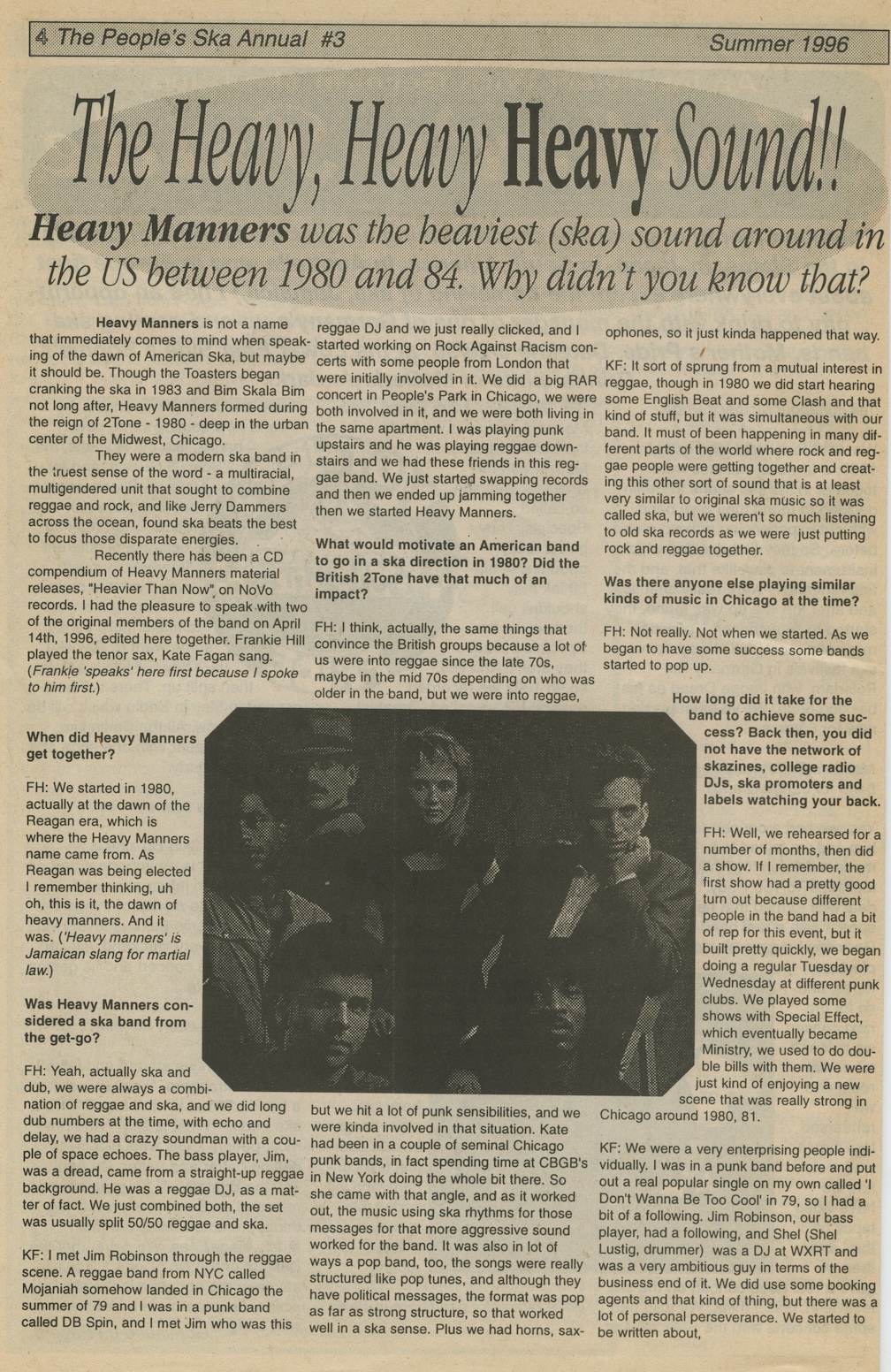
The Heavy, Heavy Heavy Sound!!
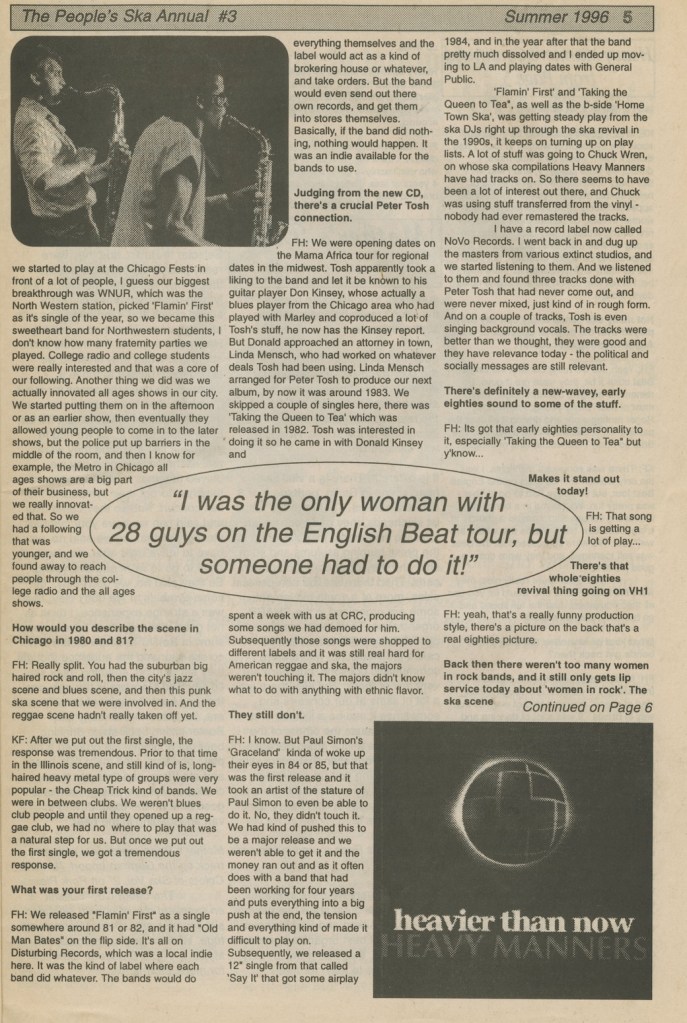
Heavy Manners was the heaviest (ska) sound around in the US between 1980 and 84. Why didn’t you know that?
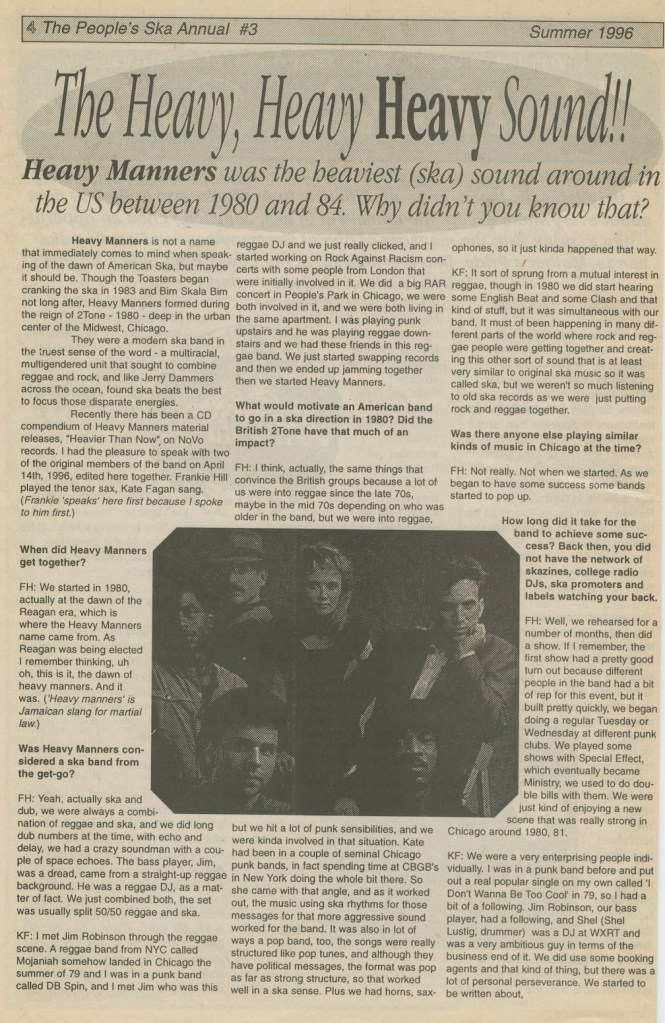
Heavy Manners is not a name that immediately comes to mind when speaking of the dawn of American Ska, but maybe it should be. Though The Toasters began cranking the ska in 1983 (ed. 1981) and Bim Skala Bim not long after, Heavy Manners formed during the reign of 2Tone – 1980 – deep in the urban center of the Midwest, Chicago.
They were a modern ska band in the truest sense of the word – a multiracial, multi-gendered unit that sought to combine reggae and rock, and like Jerry Dammers across the ocean, found ska beats the best to focus those disparate energies.
Recently there has been a CD compendium of Heavy Manners material releases, “Heavier Than Now”, on NoVo records. I had the pleasure to speak with two of the original members of the band on April 14th, 1996, edited here together. Frankie Hill played the tenor sax, Kate Fagan sang.
(Frankie ‘speaks’ here first because I spoke to him first.)
- NW – When did Heavy Manners get together?
- FH – We started in 1980, actually at the dawn of the Reagan era, which is where the Heavy Manners name came from. As Reagan was being elected I remember thinking, uh oh, this is it, the dawn of heavy manners. And it was. (‘Heavy manners’ is Jamaican slang for martial law.)
- NW – Was Heavy Manners considered a ska band from the get-go?
- FH – Yeah, actually ska and dub, we were always a combination of reggae and ska, and we did long dub numbers at the time, with echo and delay, we had a crazy sound-man with a couple of space echoes. The bass player, Jim, was a dread, came from a straight-up reggae background. He was a reggae DJ, as a matter of fact. We just combined both, the set was usually split 50/50 reggae and ska.
- KF – I met Jim Robinson through the reggae scene. A reggae band from NYC called Mojaniah somehow landed in Chicago the summer of ’79 and I was in a punk band called DB Spin, and I met Jim who was this reggae DJ and we just really clicked, and I started working on Rock Against Racism concerts with some people from London that were initially involved in it. We did a big RAR concert in People’s Park in Chicago, we were both involved in it, and we were both living in the same apartment. I was playing punk upstairs and he was playing reggae downstairs and we had these friends in this reggae band. We just started swapping records and then we ended up jamming together then we started Heavy Manners.
- NW – What would motivate an American band to go in a ska direction in 1980? Did the British Tone have that much of an impact?
- FH – I think, actually, the same things that convince the British groups because a lot of us were into reggae since the late ’70s, maybe in the mid ’70s depending on who was older in the band, but we were into reggae, but we hit a lot of punk sensibilities, and we were kinda involved in that situation. Kate had been in a couple of seminal Chicago punk bands, in fact spending time at CBGB’s in New York doing the whole bit there. So she came with that angle, and as it worked out, the music using ska rhythms for those messages for that more aggressive sound worked for the band. It was also in lot of ways a pop band, too, the songs were really structured like pop tunes, and although they have political messages, the format was pop as far as strong structure, so that worked well in a ska sense. Plus we had horns, saxophones, so it just kinda happened that way.
- KF – It sort of sprung from a mutual interest in reggae, though in 1980 we did start hearing some English Beat and some Clash and that kind of stuff, but it was simultaneous with our band. It must of been happening in many different parts of the world where rock and reggae people were getting together and creating this other sort of sound that is at least very similar to original ska music so it was called ska, but we weren’t so much listening to old ska records as we were just putting rock and reggae together.
- NW – Was there anyone else playing similar kinds of music in Chicago at the time?
- FH – Not really. Not when we started. As we began to have some success some bands started to pop up.
- NW – How long did it take for the band to achieve some suc-cess? Back then, you did not have the network of skazines, college radio DJs, ska promoters and labels watching your back.
- FH – Well, we rehearsed for a number of months, then did a show. If I remember, the first show had a pretty good turn out because different people in the band had a bit of rep for this event, but it built pretty quickly, we began doing a regular Tuesday or Wednesday at different punk clubs. We played some shows with Special Effect, which eventually became Ministry, we used to do double bills with them. We were just kind of enjoying a new scene that was really strong in Chicago around 1980, ’81.
- KF – We were a very enterprising people individually. I was in a punk band before and put out a real popular single on my own called ‘I Don’t Wanna Be Too Cool’ in ’79, so I had a bit of a following. Jim Robinson, our bass player, had a following, and Shel (Shel Lustig, drummer) was a DJ at WXRT and was a very ambitious guy in terms of the business end of it. We did use some booking agents and that kind of thing, but there was a lot of personal perseverance. We started to be written about, we started to play at the Chicago Fest’s in front of a lot of people, I guess our biggest breakthrough was WNUR, which was the North Western station, picked ‘Flamin’ First’ as it’s single of the year, so we became this sweetheart band for Northwestern students, I don’t know how many fraternity parties we played. College radio and college students were really interested and that was a core of our following. Another thing we did was we actually innovated all ages shows in our city. We started putting them on in the afternoon or as an earlier show, then eventually they allowed young people to come in to the later shows, but the police put up barriers in the middle of the room, and then I know for example, The Metro in Chicago all ages shows are a big part of their business, but we really innovated that. So we had a following that was younger, and we found away to reach people through the college radio and the all ages shows.
- NW – How would you describe the scene in Chicago in 1980 and ’81?
- FH – Really split. You had the suburban big haired rock and roll, then the city’s jazz scene and blues scene, and then this punk ska scene that we were involved in. And the reggae scene hadn’t really taken off yet.
- KF – After we put out the first single, the response was tremendous. Prior to that time in the Illinois scene, and still kind of is, long-haired heavy metal type of groups were very popular – the Cheap Trick kind of bands. We were in between clubs. We weren’t blues club people and until they opened up a reggae club, we had no where to play that was a natural step for us. But once we put out the first single, we got a tremendous response.
- NW – What was your first release?
- FH: We released “Flamin’ First” as a single somewhere around ’81 or ’82, and it had “Old Man Bates” on the flip side. It’s all on ‘Disturbing Records’, which was a local indie here. It was the kind of label where each band did whatever. The bands would do everything themselves and the label would act as a kind of brokering house or whatever, and take orders. But the band would even send out there own records, and get them into stores themselves. Basically, if the band did nothing, nothing would happen. It was an indie available for the bands to use.
- NW – Judging from the new CD, there’s a crucial Peter Tosh connection.
- FH – We were opening dates on the ‘Mama Africa’ tour for regional dates in the Midwest. Tosh apparently took a liking to the band and let it be known to his guitar player Don Kinsey, whose actually a blues player from the Chicago area who had played with Marley and co-produced a lot of Tosh’s stuff, he now has the Kinsey report. But Donald approached an attorney in town, Linda Mensch, who had worked on whatever deals Tosh had been using. Linda Mensch arranged for Peter Tosh to produce our next album, by now it was around 1983. We skipped a couple of singles here, there was ‘Taking the Queen to Tea’ which was released in 1982. Tosh was interested in doing it so he came in with Donald Kinsey and spent a week with us at CRC, producing some songs we had demoed for him. Subsequently those songs were shopped to different labels and it was still real hard for American reggae and ska, the majors weren’t touching it. The majors didn’t know what to do with anything with ethnic flavor.
- NW – They still don’t.
- FH – I know. But Paul Simon’s ‘Graceland’ kinda of woke up their eyes in ’84 or ’85, but that was the first release and it took an artist of the stature of Paul Simon to even be able to do it. No, they didn’t touch it. We had kind of pushed this to be a major release and we weren’t able to get it and the money ran out and as it often does with a band that had been working for four years and puts everything into a big push at the end, the tension and everything kind of made it difficult to play on. Subsequently, we released a 12″ single from that called “Say It’ that got some airplay in 1984, and in the year after that the band pretty much dissolved and I ended up moving to LA and playing dates with General Public. ‘Flamin’ First’ and ‘Taking the Queen to Tea”, as well as the b-side ‘Home Town Ska’, was getting steady play from the ska DJs right up through the ska revival in the 1990s, it keeps on turning up on play lists. A lot of stuff was going to Chuck Wren, on whose ska compilations Heavy Manners have had tracks on. So there seems to have been a lot of interest out there, and Chuck was using stuff transferred from the vinyl – nobody had ever remastered the tracks. I have a record label now called NoVo Records. I went back in and dug up the masters from various extinct studios, and we started listening to them. And we listened to them and found three tracks done with Peter Tosh that had never come out, and were never mixed, just kind of in rough form. And on a couple of tracks, Tosh is even singing background vocals. The tracks were better than we thought, they were good and they have relevance today – the political and socially messages are still relevant.
- NW – There’s definitely a new-wavey, early eighties sound to some of the stuff.
- FH – Its got that early eighties personality to it, especially ‘Taking the Queen to Tea” but y know…
- NW – Makes it stand out today!
- FH: That song is getting a lot of play…
- NW – There’s that whole eighties revival thing going on VH1.
- FH – Yea that’s a really funny production style, there’s a picture on the back that’s a real eighties picture.
- NW – Back then there weren’t too many women in rock bands, and it still only gets lip service today about ‘women in rock’. The ska scene isn’t a hell of a lot different.
- KF – Well, I guess just a little bit in general about the evolution of women in rock. I had thought that it would be a little more, I dunno, we were pre-MTV, and I find MTV has really objectified women in terms of being sexual objects. I guess I’m really disappointed about what video has done for women in rock. Of course there are some real strong artists I really care for who are strong on their own. With ska, I guess, it’s supposed to be about diversity, but I don’t see as many diverse bands as there might be. I’m not real out on the ska scene nowadays, though.
- NW – Not many ska bands today can say they played with the original Specials or Beat. Any interesting anecdotes?
- FH – Yeah, we did hang out with The English Beat quite a bit, they were great guys. I remember hanging out with Roger, they must of been pretty young, I remember Roger renting a car and driving it all over the parking lot of this venue like a maniac. The Brits go crazy in American kind of thing.
- KF – There was some real highlights. I was the only woman with 28 guys on The English Beat tour, but someone had to do it! That was pretty fun. We played in a bunch of interesting venues with them, in a church, in a big rodeo cow barn – it was the ‘where are we?’ tour. We were impressed that The Beat was self managed, and they were doing a good job at it. The Clash were really nice, they were the kind of band who would let you use all their equipment and the full sound and go back and play an encore.
- NW – What kind of response did they(sic) 2Tone bands get back then?
- FH – It was crazy, people were so into it. Interestingly, it wasn’t a real rough fighting kind of scene, though it kind of evolved that way in Britain – it was a lot of dancing and sweating, but it wasn’t a mosh pit and there was rude boys, but it wasn’t rude in the sense of people beating on each other and being obnoxious, it was just an over all kind of attitude, but the attitude was spiced with a lot of political thought, and a lot of social conscious thought, and I think that kept the scene vibrant.
- NW – Were there any skinheads going to the shows back then?
- FH – Yeah, there were skinheads, though it wasn’t the racist or violent ones, it was everyone mixed. Another thing that’s important is that it was very heavily black and white, too. At least in Chicago, the reggae scene was involved, so you had a lot of dreads and dub people involved. I don’t think that’s true today, today’s scene is more on the punk end of it, and the scene is straight up white.
- NW – Heavy Manners ended in 1984. Why? Some bands like The Toasters and Bim started up around ’83 when you guys were going, and today they’re still around.
- FH – That’s great that they can keep it up – it’s difficult. I think the life span of most bands who don’t achieve great success is generally 4 years or less. Those bands are really brave to stick it out, and perhaps they’ll get rewards for it.
- KF – The club scene was evolving – Chicago was not hooked up for cable for a long time after the rest of the nation. Clubs were showing videos that would otherwise pay for live music. Clubs that were large enough for us to play in were fewer in number – every Saturday night these clubs would be playing videos on big screens. It was getting into this kind of mid-eighties electronic dance club scene. We were still popular, we’d still fill the place up, but it was very hard for us to financially move forward. We were lead to believe by management that this was a salable project, so we dropped a lot of money on the Peter Tosh project, we really shot a wad on this thing, and ended up without support from anyone. At that point I was feeling that musically I wanted to do something different. There was a de-evolution in the music scene. I hear that today bands actually play for free sometimes!
- NW – The future for Heavy Manners?
- FH – Everyone has gone on with their lives. Unless this record does exceptionally well, we probably won’t do any more recording. This disc is our statement, it pretty much expresses everything we were doing and thinking at the time and, like I said, its still relevant. There’s no unfinished business.
KF – I must say that being in Heavy Manners was very fun. This is a group of people that really gets along with each other. We never had arguments except for business matters, but their(sic) was never any walking out or teaming up against each other or bickering. You have a lot of freedom as a performer and creative person and a unified politically liberal base. I think people liked to go see Heavy Manners because they saw a real unified group of people who were having a lot of fun together, but had something to say, and something that we stood for and were willing to stand out(sic) ground on it. - Mr. Hill now owns and runs NoVo Records out of his law firm to represent indie artists. After his run with General Public, he got a law degree and now works ‘on the other side of the fence’, so to speak, using his knowledge and control of the system to effect real change in the music business.
- Ms. Fagan produced a rock opera in ’84, portrayed Patsy Cline in a 1 woman show for 3 years, sang country music for a while, and now finds herself as an administrator at the High School for creative arts and pursuing a degree in journal-ism.
- All the members have gotten new college degrees since splitting up. There is a tentative plan for a reunion show at the Metro in Chicago early this summer.
- For information in regards to the CD ‘Heavier Than Now’, write to: NoVo, 208 S. Lasalle Suite 1400, Chicago, IL 60604.
Contest
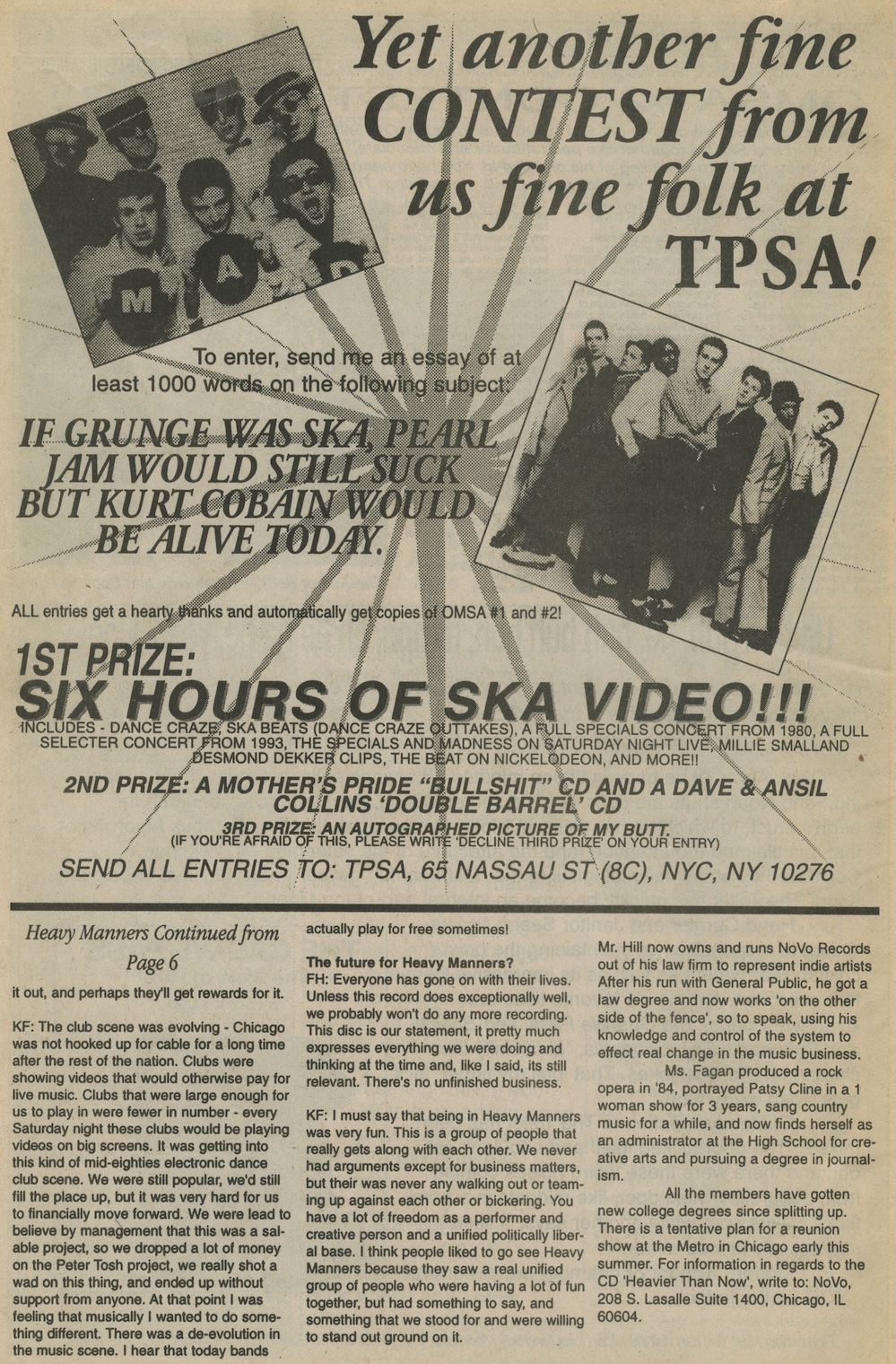
Yet another fine CONTEST from us fine folk at TPSA!
To enter, send me an essay of at least 1000 words on the following subject: “IF GRUNGE WAS SKA, PEARL JAM WOULD STILL SUCK BUT KURT COBAIN WOULD BE ALIVE TODAY.”
ALL entries get a hearty thanks and automatically get copies of OMSA #1 and #2!
1ST PRIZE: SIX HOURS OF SKA VIDEO!!!
INCLUDES – DANCE CRAZE, SKA BEATS (DANCE CRAZE OUTTAKES), A FULL SPECIALS CONCERT FROM 1980, A FULL SELECTER CONCERT FROM 1993, THE SPECIALS AND MADNESS ON SATURDAY NIGHT LIVE, MILLIE SMALL AND DESMOND DEKKER CLIPS, THE BEAT ON NICKEL@DEON, AND MORE!!
2ND PRIZE: A MOTHER’S PRIDE “BULLSHIT” CD AND A DAVE & ANSIL COLLINS ‘DOUBLE BARREL’ CD
3RD PRIZE: AN AUTOGRAPHED PICTURE OF MY BUTT. (IF YOU’RE AFRAID OF THIS, PLEASE WRITE ‘DECLINE PRIZE THREE’ ON YOUR ENTRY)
SEND ALL ENTRIES TO: TPSA, 65 NASSAU ST (8C), NYC, NY 10276
Contact
TPSA, c/o Noah Wildman, 65 Nassau St (Apt. 8C) NYC, NY 10038